
x
S
A
R
I
S
K
A
-
50 London Road, Alderley
Edge, SK9 7DZ
Visit Us
- 50 London Road,
Alderley Edge, SK9 7DZ - Mon - Tue - 4:30 pm – 11:00 pm
- Wed - Thu - Sun - 12:00 pm – 11:00 pm
- Fri - Sat - 12:00 pm – 11:30 pm
- admin@sariskadining.com
If you've ever had an Indian curry that tastes extraordinary one week — then oddly flat the next — you've already noticed the difference between authentic Indian cooking and what happens when kitchens take shortcuts.
Authentic Indian food isn't about being elaborate or expensive. It's about doing the basics properly: building flavour in stages, using spices with intention rather than just for heat, and giving ingredients the time and care to actually taste like themselves.
In a small town like Alderley Edge, you don't have an endless rotation of restaurants to choose from. You want a place worth returning to — where the portions are generous, the flavours are consistent, and the food feels genuinely cooked rather than assembled.
Below is a straightforward, behind-the-scenes look at what separates authentic Indian cooking from the shortcuts that make curries feel "samey."
What People Mean by "Authentic Indian Cooking"
"Authentic" doesn't mean one fixed style. Indian home cooking varies hugely by region, family, and even the occasion.
But it tends to share a few core traits:
-
Flavour is built in stages — not added at the end.
-
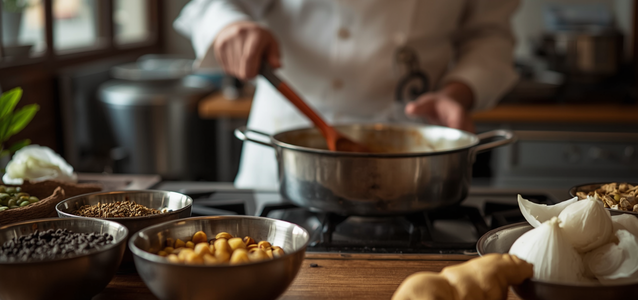
Onion, tomato, ginger, and garlic are cooked to the right point: sometimes slow and caramelised, sometimes browned for depth.
-
Spices are treated as individual ingredients, not a catch-all powder.
-
Curries are given enough time to come together properly.
-
Balance matters — warmth, tang, richness, and aroma — without relying purely on heat.
It's the kind of traditional Indian food that tastes "proper" even when it's relatively simple. And it's precisely this approach that separates a memorable curry from a forgettable one.
The Most Common Restaurant Shortcuts (And How They Change the Flavour)
Shortcuts exist for a reason. Busy kitchens need speed and predictability. But some shortcuts affect the end result in ways you can taste.
Here are the most common ones:
1) A One-Size Base Sauce
Many restaurants use a large batch "base" to speed up service. It can create consistency, but it can also make multiple dishes feel like they share the same starting point — because they do.
You might notice:
-
A similar sweetness across very different dishes
-
A "canteen" quality to the smell or taste
-
Less distinction between a rogan josh and a bhuna
The difference between authentic curry and a shortcut version often starts right here.
2) Pre-Mixed Spice Blends
Pre-mixes are convenient, but they tend to lean on a handful of dominant notes — strong chilli, cumin, or a generic "curry powder" profile. That can flatten the dish significantly.
You might notice:
-
Heat that arrives without any layered aroma
-
A slightly dusty aftertaste
-
No fragrance when the plate is placed in front of you
Fresh spices in Indian cooking behave completely differently. They bloom in oil, release complexity, and give each dish its own clear identity.
3) Rushing the Cooking Process
Some flavours only develop with time — particularly onions, tomatoes, and whole spices. When a slow-cooked curry is instead rushed to the plate, the result shows:
-
Sharpness where there should be richness
-
A sauce that tastes separate from the meat or vegetables
-
A strong first bite that fades quickly, with little depth underneath
4) Using Cream, Sugar, or Extra Oil to "Round Things Out"
Cream and butter have an entirely legitimate place in Indian cooking. But when they're used to compensate for a sauce that hasn't developed enough, the result is richness without complexity — heavy on the palate, but missing that satisfying savoury finish.
Why Slow-Cooked Curries Taste Deeper (It's Not Just "More Spice")
A common assumption is that a great curry is simply about adding more spices. In reality, depth comes from how things are cooked, not only what goes in.
Here's what proper, slow-cooked curry actually does:
-
Onions transform: Cooked properly, they move from sharp and raw to sweet and savoury — giving the sauce a much fuller, rounder base.
-
Tomatoes mellow: Simmering removes that raw, acidic edge and turns it into a gentle, rounded richness.
-
Spices bloom: When added to oil at the right moment and temperature, spices release aroma and warmth rather than bitterness.
-
Everything merges: Meat, vegetables, and sauce stop tasting like separate elements and become one coherent dish.
That's why a properly slow-cooked curry tastes "finished." You don't find yourself reaching for extra salt or chilli — the depth is already built in.
Understanding how curries get their depth is really understanding authentic Indian cooking at its most fundamental level.
Fresh Spice Blends vs Pre-Mixes: What You Actually Taste
Spices are a bit like coffee: the fresher they are, and the more carefully they're handled, the more of the good stuff comes through.
With a thoughtful, fresh spice approach in Indian cooking, you'll notice:
-
Aroma first: You smell the dish before you even taste it — a warm, complex signal of what's coming.
-
Layered warmth: Not just heat, but clove-like sweetness, peppery notes, and toasted depth arriving in sequence.
-
Clear dish identity: A chicken tikka masala tastes genuinely different from a karahi — not just hotter or milder.
Pre-mixes can still produce a decent result, but they tend to deliver one main note rather than a profile that builds. That's the real difference between authentic Indian cuisine and something that approximates it.
The Base Sauce Question: Consistency vs Character
Most diners never think about it, but the "base" — the foundational sauce a kitchen builds each dish from — is one of the most important decisions a restaurant makes.
A kitchen can absolutely be consistent and have genuine character — if the base is treated as a foundation rather than a shortcut to the finish line.
The difference usually comes down to details:
-
Are the onions cooked to the right point, or simply softened?
-
Are spices added at the right moment, or all at once?
-
Is each dish finished with ingredients that belong specifically to that dish — particular spices, herbs, or cooking techniques?
When it's done properly, you get both: the consistency to trust your favourites every time, and the distinct flavour that makes each dish its own thing.
Behind the Scenes at Sariska: Keeping It Authentic Without the Fuss
At Sariska, the goal is straightforward: proper authentic Indian food you can return to regularly — bold flavour, generous portions, and quality you can rely on.
Inspired by the culinary traditions of Rajasthan, the kitchen approach at Sariska is built around what makes traditional Indian food actually taste the way it should:
-
Building flavour in stages rather than rushing toward the finish line
-
Treating the basics — onion, ginger, garlic, tomato, spice — with genuine care
-
Matching cooking methods to each dish (some need a long, slow simmer; others call for a hotter, drier finish)
-
Keeping the food food-led: so you taste the curry, not just "heat"
Explore the Sariska dinner menu to see how this approach plays out across the full range of dishes — from the Sariska Special Chicken to the Hyderabadi Chicken and Shashlik Karahi Lamb.
Why It Matters Locally
In many local dining scenes, Indian restaurant food can drift toward "one menu, one taste" — quick-to-serve curries that feel interchangeable across different dishes and even different venues.
At Sariska — Alderley Edge's home for authentic Indian dining with a Rajasthani heart — the aim is dish-by-dish character: a bhuna that genuinely tastes like a bhuna, a madras with real definition, a balti that isn't just "the same sauce, different label."
That's the kind of consistency worth coming back for. Read more about what home-style really means at Sariska and how it shapes everything on the plate.
How to Spot Authentic Indian Cooking When You're Eating Out
You don't need to be a chef to tell the difference. The next time you're eating Indian food, look for these signals:
-
The aroma arrives before the food does — a warm, complex smell when the plate is set down.
-
The sauce tastes "cooked in," not like it was stirred together and heated through.
-
Different dishes genuinely taste different — not just a spectrum from mild to hot.
-
You can identify the individual ingredients — tomato, ginger, onion, spice — without any single element dominating.
-
It feels satisfying rather than heavy — rich where it should be, but not oily for its own sake.
If you're wondering how to identify a genuinely authentic Indian restaurant, these are the sensory clues that matter most. A kitchen that gets them right, gets them right consistently — because consistency at this level only comes from doing the same things properly every time.
The Simple Takeaway (And What to Try Next Time)
Authentic Indian cooking beats shortcuts because it respects the process: build the base, bloom the spices, simmer for depth, and finish with balance.
If you're deciding what to order next time, a useful test is to pick two very different styles — a bhuna and a rogan josh, for example — and see whether each has its own clear identity. When they do, you've found a kitchen that's genuinely cooking.
Here's how to order Indian food for the table without the usual guesswork.
If you'd like to explore the best curries and biryanis on offer, Sariska's menu gives you plenty of reference points — dishes built with the kind of slow-cooked curry technique that makes the difference genuinely tasteable.
And if you're bringing the family along, there's a straightforward guide to ordering Indian food for a family night out that takes the guesswork out of the whole thing.
Book a table at Sariska and taste the difference that authentic technique actually makes.
FAQ Section
Q: What makes Indian cooking "authentic" compared to a typical restaurant curry?
Authentic Indian cooking builds flavour in deliberate stages — properly caramelised onions, bloomed spices, and a long enough simmer for everything to come together. The result is depth and complexity rather than a uniform "curry" taste. Most shortcuts sacrifice one or more of these steps.
Q: Why do some curries from the same restaurant taste similar to each other?
This often comes down to a shared base sauce. While a base speeds up service, if every dish starts from the same pot without individual finishing, the distinct character of each curry gets flattened. A bhuna should taste very different from a rogan josh — and it will, when each is cooked properly.
Q: Is slow-cooked curry actually better, or does it just take longer?
The time is the point. Slow cooking allows onions to sweeten, tomatoes to lose their raw acidity, and spices to fully bloom in oil. These are chemical changes — not cosmetic ones — and they create the layered, rounded flavour that characterises a genuinely well-made curry. Speed shortcuts those changes, and you taste the difference.
Q: How can I tell if an Indian restaurant uses fresh spices or pre-mixes?
The clearest signal is aroma. Fresh, well-handled spices produce a warm, complex smell when the dish arrives. Pre-mix-heavy dishes often smell generically "spiced" rather than specific. Also pay attention to whether different dishes genuinely smell and taste distinct — if they all share the same base note, a pre-mix is likely doing most of the work.
Q: Where can I find authentic Indian cooking in Alderley Edge?
Sariska Dining on London Road, Alderley Edge serves authentic Indian and Rajasthani cuisine with a genuine emphasis on traditional technique — slow-cooked dishes, fresh spice handling, and dish-by-dish character rather than a one-taste menu. You can view the menu or book a table directly online.